Saturday, October 28, 2006

Pin Punches: An Endangered Species

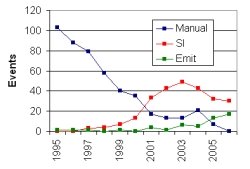
Tomorrow's event at Chobham Common will mean that I have gone a whole year (and 55 events) since I last used pin punching. The graph shows how pin punching has almost died out at events I have run since I first used Emit at an event on 28th June 1995 in Norway. The only upward trend on the manual punching curve was in 2004 when I ran several of the Sydney Summer Series races which still use pencils to write on control cards! The start of the SI take-off was the Scottish 6-Day in 1999, after which most of Great Britain bought SI equipment. The apparent recent rise of Emit has two main causes. It is now used widely in the South Central, so that gives me five to ten races a year. It is also used at various overseas multi-day events I have been to, such as the WOC spectator races this year. My guess is that future years will see a fairly steady trend of SI above Emit, with the odd rare pin punching event.

Out of interest I've looked at when I last used pin punching at various types of event:
  • Badge Event: Virtuous Lady (DEVON) on 28 May 2000.
  • National Event: Brown Clee Hill (HOC) on 26 March 2000.
  • JK: Winterfold, Hombury and Pitch Hills (SEOA) on 4 April 1999.
  • British Championships: Graythwaite (NWOA) on 8 May 1999.
This weekend is also exactly 9 years since the first use of SI at a race in Great Britain. This was at the short race at Euromeeting 1997 held in the Lake District. I was one of those helping out behind the scenes and trying to work out what to do to make the system work, whilst the world's elite runners went through the same experience out in the forest. Everybody coped OK and the rest is history, as shown by the graph. For those desperate for more information I wrote a CompassSport article in 1999 that outlines the history of electronic punching in Great Britain.

Tuesday, October 17, 2006

Virtual orienteering heaven

The new release of Catching Features has finally arrived. If you've never tried it then I suggest downloading the demo immediately, and then paying your money to buy the full version. It is a fantastic orienteering simulation, with a huge range of maps and courses to try out, plus a world-wide ranking system and on-line competitions. Don't miss downloading the World Championships maps and courses from Japan 2005, Sweden 2004 and Switzerland 2003.

The main feature of the new release provides a vastly improved map conversion utility. This takes in an OCAD map and spits out a virtual model of the map that you can then set your own courses on. People have managed to make some pretty impressive maps with the old editor, but it was hard work and took a long time. The new editor is simply amazing. I've had a quick play with some real OCAD maps and within just a few minutes you can produce very accurate conversions. As an example, the left-hand picture is a screen shot from a conversion of Campbell Park, as used for the British Sprint Championships this year. The right-hand picture is one of the photos I took whilst checking sites before the race. The main difference is the fence in the converted map, which hadn't been put up when I took the photo!

I'm sure we'll start to see even more conversions of world-class areas in the near future so you can spend the long dark nights practicing your O technique, just like Thierry does. It strikes me that we could be getting close to a new discipline: indoor orienteering. It doesn't look too difficult to connect Catching Features up to a treadmill, and then you could make the running speed in the game proportional to the speed of the treadmill. You could then have indoor orienteering races just like they have indoor rowing world championships on rowing machines. Just a thought.

Tuesday, September 26, 2006

WOC Database Updated

I've now managed to get all of the WOC relay results in to the Maprunner WOC Database. The individual runners from each team are still missing, but all the team results are there. There has been quite a lot of interest from around the world, so I'll keep adding things when I have time.

A few interesting things I spotted whilst getting the relay result queries to work:

- Great Britain had their worst-ever relay results for both Men and Women in Denmark 2006.

- No Swedish relay team has ever finished lower than 4th (discounting disqualifications in 1997 and 2001), and they have won 41 medals out of a possible 46: truly staggering. At least I assume the Swedish men were disqualified in 2001 in Finland, since they don't appear at all on the results list on the IOF web site.

- Five countries have won 128 relay medals between them. That's over 92% of the possible medals. Five further countries have won the remaining 10 medals.(Try naming these 10 countries before looking up the answer here.)

Monday, September 11, 2006

Parakeets at Hampstead Heath

I controlled the London Orienteering Klubb event on Hampstead Heath yesterday. Hampstead is only four miles from central London, but offers fantastic terrain with open fields, heathland and even some reasonable areas of wooded contour features. The weather was great with bright sunshine during the day, even if there had been thick mist when the controls were being put out.

LOK used pre-marked maps printed on Pretex again, after a first test at Trent Park earlier this year. This seems to have overcome most of the problems of previous types of waterproof paper that have been tried for orienteering maps, and everybody I spoke to felt that it was worth trying to use it more widely.

Despite having mapped, planned and controlled on Hampstead Heath many times, yesterday was the first time that I had seen the exotic new population of ring-necked parakeets that have taken up residence around the lakes near Kenwood House. These bright green birds are unmistakeable, and even if you don't see one you will certainly hear them. My previous most exotic sighting on the Heath was probably the comedian and TV presenter Michael Palin who ran past when I was hanging controls for an event about 15 years ago.

Friday, September 08, 2006

The Power of World of O

My website normally goes along averaging about 200 hits a day. So why did I suddenly get 10 times the traffic on Wednesday? Because Mike Eglinski wrote something in his OKansas blog that was reported on World of O and lots of people found it. The story goes back even further, because Mike wrote the article because I'd emailed him about something else that he'd written a few days before, that I had read because of his link from World of O. How many other sports have such a powerful gateway into all aspects of the sport from the very top (read all about Simone's trip to a Robbie Williams concert!) to the very bottom (power is now restored at the BOF office!).

I've had a quick look through some of the other statistics for Wednesday. The average orienteer is running Firefox on Windows XP. Internet Explorer was used for well under 50% of accesses, which I guess indicates that orienteers are quite sophisticated when it comes to the internet<.

It's noticeable that the most-read articles on World of O fall into two main camps: websites of the superstars, and anything written in English. I can struggle through Thierry's site in French, and get through various Swiss sites in German if assisted by Babelfish. I know a few key words in Swedish and Norwegian, and there's always the maps to look at. How long before you'll be able to get a translation from any language to any other language for any website? Stars who post in English are guaranteed a large audience, so thanks to people like Holger Hott Johansen, Oystein Kvaal Osterbro and Pasi Ikonen for letting us in on their secrets.

Today's thought that struck me whilst writing about something else: Everybody in orienteering knows who Simone, Thierry and Jamie are without needing any further information. Looks like you can add Hanny to the list.

Wednesday, September 06, 2006

Running to catch up

After a period of silence it's time to try to catch up. There have been all sorts of things I have been meaning to write about, but just never seemed to get round to. The moral is to do it little and often, rather than trying to write carefully crafted pieces as you would elsewhere. Let's see what you missed:
  • The World Rowing Championships, which were held at Dorney Lake near Eton. We went along to one of the qualifying days just to get a feel for what the World Championships of another sport are like. Lots of similarities, lots of differences, but it must be said that orienteering came out OK by comparison with what is meant to be a much higher-profile Olympic sport, and one which clearly has a lot more money involved. WOC 2006 definitely had a bigger screen than them!
  • The World University Orienteering Championships. GB showed yet again that they have potential, even if not quite in the expected places. The men had an average week, but the women got it all together and won the relay. Again.
  • The BOF Major Events Conference. I was drafted in at a late stage to present the planning sessions, and spent an enjoyable weekend in Slimbridge with the key officials from BOC, BRC, JK and National Events in 2007 and 2008. This reconfirmed the dedication of people to putting on high-quality events, but also reinforced that we still aren't finding enough new people to take on major roles. I was the youngest person there. We even managed to get a few more things sorted out about JK 2008, which will be in the south east.
  • The WOC database that I have now got to a stage where it is producing quite interesting results. More coming soon about that one...

Friday, August 18, 2006

WOC Results and Statistics

I've commented previously that it turned out to be very hard to find a good source of results for WOC. I'm looking at setting something up to allow a bit of research into how results have changed over the years and produce some statistics. Watch this space. Whilst doing this I have finally found a fantastic site with everything I needed. This is maintained by Bryan Teahan on behalf of the New Zealand Orienteering Federation.

And as a taste of what might be coming, how about this table. It is a full list of all GB runners who have reached the top 10 at the World Championships. Congratulations to Graham Gristwood and Helen Bridle who put themselves on the list in Denmark this year.

PosName% behindRaceYearCountry
1Jamie Stevenson0.00%Sprint2003Switzerland
1Yvette Baker0.00%Short1999Scotland
2Yvette Hague4.30%Long1995Germany
2Yvette Hague1.20%Short1995Germany
3Heather Monro7.00%Sprint2005Japan
3Jamie Stevenson0.50%Middle2006Denmark
3Yvette Hague5.90%Long1993United States
4Steve Hale3.90%Short1993United States
4Yvette Baker1.60%Long1999Scotland
5Jamie Stevenson3.40%Sprint2001Finland
6Helen Bridle7.60%Sprint2006Denmark
7Carol McNeill7.60%Long1979Finland
8Heather Monro4.40%Long1999Scotland
8Jamie Stevenson4.90%Long2004Sweden
8Steven Hale4.70%Short1999Scotland
8Yvette Hague7.30%Long1997Norway
9Graham Gristwood4.50%Sprint2006Denmark
9Heather Monro10.00%Middle2004Sweden
9Sarah Rollins10.10%Sprint2003Switzerland
9Yvette Hague9.10%Short1993United States
10Heather Monro15.50%Middle2003Switzerland

Thursday, August 10, 2006

A Great WOC, That's For Sure

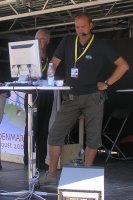
Is this the real star of WOC2006? The photo shows Per Forsberg, chief speaker for WOC 2006, and apparently a well-known TV commentator on football and athletics in Sweden. Many of you will already be familiar with his fast, loud and enthusiastic commentary, and will also recognise his many catch phrases, especially "he's too late" and "that's for sure". For those who have never heard him, think Jonathan Pearce with a slight Swedish accent.

Per kept up what seemed like a continuous stream of well-informed commentary throughout the whole of WOC. He was clearly supported by an extensive array of radio control times, TV cameras and real-time tracking information from TracTrac, as well as a team of helpers who were picking out the real action. The spectators got only part of this information, with limited viewing of the tracking information. The big screen was the biggest I've ever seen, and was used well to present a mix of split times, finish times and shots from the forest. From what I can tell it would appear that people watching via the internet probably had more information available, since they could access everything Per had. So in some ways this was the first year when watching from home really seems to have been a valid option.

So what did you get from being there? I guess it's the same question for any sporting event. There was a real sense of atmosphere at every race, with an awful lot noise (especially from Swiss cow bells) and huge numbers of flags, especially Swiss, British, Finnish and Swedish. The race arenas themselves were in fact marginally too small for the numbers that turned up, and the main spectating areas were very hard to move through at the Middle and Relay races because there were simply too many people crammed in. Apparently the Sprint race could have used an athletics stadium for the finish, but the organisers were worried that this was too big and would have looked empty. There were excellent facilities at each race, with huge tents supplying food and drink, plus an ice cream van and beer van each day, and the weather overall was warm and sunny, with just an occasional thunderstorm. And of course you have to be there spectating in order to be able to run in the forest afterwards to find how hard it really was.

There were also several points where the reaction of the crowd really added to the suspense. Remember that an orienteering crowd is extremely knowledgeable about what is going on, and has a pretty good idea of who should be doing what and when. The things that caused the biggest gasps or cheers throughout the week were:
  • Simon Niggli punching the spectator control 6 seconds down on Hanny Alston. That was the point when the crowd worked out there was a real prospect of a huge upset.
  • The tracking display of the long leg on the Men's Long Final, showing runners taking very different route choices. The biggest shock was when Jani Lakanen appeared to stop dead, but we then worked out that this was because we had caught up to real time and he was still doing the leg.
  • David Andersson of Sweden punching the spectator control at the Middle Final and then running the wrong way along the tapes and starting the last loop backwards. I'm surprised that the gasps from the crowd weren't enough to tell him something was wrong.
  • The many mistakes that showed up on the tracking for the Middle Race and Relay, where what we all thought were the world's best orienteers proved that they were human too. Particularly for the Relay it seemed that nearly everyone had a go at making a serious mistake when in or near the lead.
And finally a thought that no-one else seems to have picked up on yet. The Middle Race was originally meant to be include a Micro O section to add spectator interest. Luckily, in my opinion, the WOC organisers failed to get the financial support to do this. What we saw was a fantastic, and spectator-friendly, Middle Race with no need for gimmicks or compromise. Let's stick with proper orienteering for the World Championships, and let the races speak for themselves.
Saturday, August 05, 2006

WOC+8: Who wants to win the relays?


A weird day at the relays, where several of the top teams got into a good position only to throw it away with quite serious mistakes. Norway, Sweden and Switzerland were all guilty, leaving Finland to take the Women's race and Russia to take a surprising gold in the Men's race. The French men were never in contention, and the two British teams both started well but faded away.

The overall TV coverage and commentary was excellent and made following the races very easy and exciting. The tracking system also showed numerous errors at critical points. It was a strange decision to show tracking on aerial photographs rather than the O map until most of the third leg runners had started, since the critical information was all available to the watching runners (gaffling, left and right route choice options).

So that's WOC for another year. Who fancies a week in Kiev next year?

WOC+7: Jamie Stevenson World Champion TM part 2


Well maybe not World Champion again, but a bronze medal in the Middle Race was a pretty impressive achievement. The crowd was crammed onto a steep slope overlooking a spectator control and the run-in. Crowd highlight of the day was undoubtedly the Swede who punched the spectator control and then followed the tapes the wrong way and started running the last loop backwards.

The tracking today showed a lot of quite critical errors, with several medal contenders making mistakes that cost critical seconds and even minutes. Thierry made a large error at number 4 that cost him the race, but several others threw away the gold medal as well. In the women's race it was another close call for Simone but she just held on.

In the afternoon we got a chance to try for ourselves and found quite how intricate the contours were. Strangely the area was very similar to parts of the North Downs (Leith Hill or Holmbury for example) and the Brits should certainly have felt at home.

WOC+6: Picnic time

A day off for the big boys, but day 4 of the WOC Tour for us, and a chance to see the Long Distance area. Pleasant enough but nothing special was how I felt afterwards. Not as physical as the qualifier, and actually quite dull at the end when the contours ran out and the navigation got simple. Looking at the men's course it looks like they suffered the same fate, with a ditch junction near the end being a particularly poor control site.

And then on to the traditional British Team picnic. After various exotic locations this one ended up in a corridor in the Radisson Hotel. The British supporters turned out in force and filled the corridor, much in the way that the various events seem to have event arenas not quite big enough for the crowds turning up.

As you may have guessed, it's proving hard to keep up to date, so expect some short reports to follow, with quite an exciting thing happening very soon...

Thursday, August 03, 2006

WOC+5: Normal service is restored


The long distance final restored normal order, but only just. Pre-race favourites Simon Niggli and Janne Lakanen took gold, but it was close at the top, with several nations having a good day. The GB team had one of those days we now expect: nothing spectacular but pretty reasonable really. Difficult to cheer, but better than it feels at the time, as I seem to have written so often in reviewing WOC history.

From the spectating point of view the event arena was good, with everything in a long thin field in a valley. The run-in was along the bottom, with spectators sitting on the side looking down on the action. There was the token spectator control. This was a wooden platform behind the run-in that, as usual, meant a run down to it and then back out without providing any real orienteering merit other than to show the runners to the crowd. The big screen is really very big, and people are beginning to understand what to show on it. The TV control had enough cameras to build up some tension as people approached and you could see the runner's position gradually slipping down the field. There was a brief appearance of the tracking system, showing a long leg on each course and giving a first idea of how critical some of the route choices appear to have been. However it is still very difficult to integrate this into a real-time commentary, and I still think it is more useful for a highlights programme after the event.

Without seeing the splits it is difficult to be sure, but it seems there were some fairly large packs forming again. Lakanen certainly ran a large portion of the race with Gonon of France, dragging him into the top 10 (or was it the other way round?). Jamie Stevenson apparently ran the whole course on his own, which must have cost him time. Just one of those things if you accept a 2 minute start interval.

So two races gone, two to go. Another rest day for the poor elites whilst we spectators get to see what the area was really like.

Wednesday, August 02, 2006

WOC+4: Queen of the South

So now we know Simone can be beaten, and by a junior at that. Hanny Alston from Australia took gold in the sprint final at the end of a hectic day for the elites, the also-rans and I'm afraid to say the event officials.

Didn't have time to fit in a visit to spectate at the Qualifier, but the news was good for GB with everybody through. My secret weapon in the O-Manager game, Troy de Haas of Australia, got disqualified and then reinstated after they decided two controls were less than 30m apart. An Irish runner got re-instated because a car was parked in front of a control. The perils of sprint race planning and controlling. WOC Tour race in the morning was pleasant but nothing special. Heather Monro came out of World Championships retirement to win W21E.

Car parking for the Opening Ceremony was chaos. Glad I don't live in one of the local streets. Ten minute walk through light rain to get to the arena, but the weather then brightened up nicely until everything was over. The opening ceremony was slightly strange and one of the worst examples of its kind. It never really got going or seemed to have any point. The Crown Prince of Denmark did a short speech in which he attempted, and managed, simultaneously to sound like Prince Charles and Tony Blair. The finish area itself was quite impressive with massive grandstands for the spectators, even though the sight lines weren't particularly great. Finish out of sight to the left, spectator control out of sight behind the stage. The Swiss won the "bring a flag" competition, and it looked like Norway had forgotten there was an event on. Perhaps they knew what was to come, with Norway having a terrible set of results.

The men's race was looking good for GB all the way. BJ came in early and in the lead, GG had an absolute stormer and was in the lead at the spectator control. He lost a few seconds in the last loop, and reckoned his ninth place could have been a top six. Matt Speake got disqualified for crossing an uncrossable fence. So did Troy de Haas; the first person ever to be disqualified in a World Champs Qualifier and Final on the same day? The British women went even better than the men, with Helen Bridle finishing sixth, Pippa Whitehouse 12th and Sarah Rollins 16th. But is was the last few moments that will be remembered. Hanny Alston finished to take the lead, having been towed round the last loop by Helen. Just after that Simone punched the spectator control and we knew she was six second down on the lead. Could she do it? Not this time. Perhaps she'll have to settle for only three golds this year. Or is someone else out there going to take another one away?

Tuesday, August 01, 2006

WOC+3: WOC Tour Day 2

Another day, another event to run. This time the WOC Tour was just south of Arhus in the forest along the coast. This was predominantly beech with some interesting contour detail at 2.5m, not too much unpleasant vegetation but a very dense path network. It was certainly a bit easier to run than the previous day, and speeds increased all round.

Then it was another hard day sightseeing (bog man plus Viking and Roman remains in the Moesgard museum, which just happened to be the car park for the event) followed by a quick trip to the beach (water temperature 21C if you believe the sign by the life guard's hut).

And now the real event starts. Looks like we won't have time to make it to the qualifier in the morning, so it's WOC Tour Day 3 first (same place as yesterday) followed by the Opening Ceremony followed by the first final. Optimistic British spectator view says six through to the final, top 10 places for Sarah Rollins and BJ. Super-optimistic British spectator view puts GG in the top 10 as well, and gives BJ a medal. Norway, Finland, Sweden, Denmark, France, Switzerland, Ukraine, Russia and even countries like Italy and Australia will also think they've got a chance of a medal.

Sunday, July 30, 2006

WOC+2: Long Distance Qualification


After a hot day spectating and competing in the Danish sunshine we can now start to answer those important questions that all spectators need to ask. Nobody has gone for a really outlandish new O-suit this year, and the new British kit is a subtle red, white and blue that seems to look better in photos than it does in real life. The Norwegians are still running round in kit that looks like it has been washed too often, and at least some of the Swedes have thrown away the sleeves of their O-tops along with the rule book that says they should have them. Enough on the fashion report.

Second important question is what is the terrain like. My WOC Tour M40 course of 7.8km took 84 minutes, which sounds pretty awful until you factor in 430m climb (that the Danes cunningly avoid bothering to mention). I could say it's like Cannock Chase or the Chilterns or Bury Walls or Mytchett but the thing it is most like is of course Denmark. Pleasant enough in most places, but with some truly horrid walk (I didn't risk the fight) and relentless short sharp climbs. Vegetation turned out to be better than I'd feared, with a fair amount of quite low bracken, and some stinging nettles hiding to keep you awake when you ran into them by accident.

As for the WOC Long Qualifier it was basically more of the same. All the big names got round safely, with the superstars making it look easy. Simone, Thierry (the only two who qualify as first names only), Nordberg, Lakanen, Novikov and Jukkola all cruised in. The Brits had a standard mix of solid (Jamie Stevenson, Jon Duncan, Alison O'Neill and Rachael Elder), nail-biting (Jenny Whitehead qualifying by two seconds in 15th place) and huge disappointment (Oli Johnson controversially disqualified for mispunching). Performance of the day must go to the Chinese girl Mingyue Zhu who qualified for the final in 15th place: time to start getting worried about the emergence of a new orienteering superpower?

And now those poor elite runners are so tired they need a day off, so that's it until Tuesday for them. Seems a strange timetable, but at least us also-rans are made of sterner stuff and have a race tomorrow. Then there's time to speculate on who might win what on the form we have seen. It still looks to me like things are going to be very close. All 45 men's middle race finalists finished withing 4 minutes of the leader in the qualifier, and the spread today was only 10 minutes. Perhaps that's why we seem to have reverted to results in 10ths of seconds. So roll on the Sprint Qualifier on Tuesday morning, just in time for some people to have their last run at WOC before the opening ceremony and sprint final on Tuesday afternoon.

Saturday, July 29, 2006

WOC+1: Here we go


Two days of silence whilst we were traveling avoided the problem of getting to WOC-0, since I clearly miscalculated two weeks ago.

Anyway, the day on the ferry to Esbjerg was fine, and we spent the evening in a pleasant log cabin with swimming lake right next to it.

The following morning the weather broke for real, and we had torrential rain and thunder and lightning for two hours. After debating the options we pressed on and spent the day at Legoland, which turned out to be not too bad. There was only one surreal ride on a boat round famous locations in the pouring rain, but otherwise the sun returned for the assortment of trains, boats, fire engines and various other rides I was forced to go on.

Got to the WOC camp site in Arhus later in the evening to find it was not quite what we had hoped, lacking in nearly all facilities other than a flat grass field. We shall see how long we last here.

And then WOC Day 1, as things started with the Middle Race Qualifier. As a seasoned WOC Spectator this was one not to miss, but the rest of the family convinced me that the beach was a better bet. We even found a Viking Festival going on, complete with several hundred Vikings and horses acting out a pitched battle, plus a huge area of tents selling all sorts of Viking things (honestly).

On the results front it seems that the Brits did pretty well without me, with all six making it to the final. WOC for real tomorrow as we'll be at the Long Qualifier before starting Day 1 of the WOC Tour.

Wednesday, July 26, 2006

WOC-2: Looking East from Down Under

WOC 2005 was in Japan, so just for a change I decided to spectate from Australia. I spent the summer working in Sydney, and therefore ended up catching some of the races over a wireless link to my laptop sitting in various cafes in central Sydney. Technology at my end had certainly moved on, even if the internet coverage was still confined to split times and results.

This time it was Heather Monro we were all yelling for. She'd taken a medal at the World Games, in Germany, and this was going to be her last WOC. Could she finally get it all together on the big day? Of course she could: bronze in the sprint race and she became the third Britain, after Yvette and Jamie, to take an individual World Championship medal. Elsewhere it was Simone and Thierry showing how it should be done. Simone did the impossible again, taking all four gold medals. Thierry only won the middle race (and nearly the relay) but that did mean he'd won three World Championships in a row.

So that's all there is from my personal history of spectating at WOC. This afternoon we set off for Harwich to get the ferry to Esbjerg. On Friday we're going to Legoland (since it's on the way to Arhus, honest). All that's left to do before we go is to pick my own WOC team in the O-Manager game? Do I pick the Brits and hope they do well? Can I resist picking Simone (or can I even afford her)? Will the Swiss, Finns, Norwegians and Swedes dominate, or will the French, Brits, Russians, Czechs and Australians have a good week. How good are the Danes on home terrain? Will it really be as hot and sunny as the weather forecast says? We'll soon find out.

Tuesday, July 25, 2006

WOC-3: Return to Sweden

WOC 2004 was in Sweden, just one year after Switzerland. The IOF had decided that more World Championships was what the sport needed. As I spectator I wasn't sure this was true, and it made it easier not going to Switzerland since I knew I couldn't possibly keep going every year. The new format it is beginning to grow on me and I guess I've at least moved to being neutral now. Not sure about some of the runners though.

This was therefore another chance to test the remote spectating facilities of the internet. The main thing I remember is that they put the maps up during the race so you could see the course people were running and get an idea about the critical legs. As far as results went for the Brits this was another year of not bad but not great results. To be honest I can't remember getting particularaly excited at any point, other than possibly trying to work out how Simone had lost so much time early in the classic race.

So a bit of a non-event altogether. Perhaps you had to be there.

Monday, July 24, 2006

WOC-4: Jamie Stevenson World Champion TM

The sequence was never going to go on for ever, so I didn't make it to WOC 2003 in Switzerland. Instead I had to settle for sitting at home with an internet connection to find out what sort of facilities the Swiss had managed to provide. Luckily I have a job where I can work from home occasionally, so I managed to arrange to be in for the main races. 

The strange thing about Switzerland is that we probably didn’t have particularly high expectations. Heather and Jamie were clearly in with a chance, but after Finland the thought of medals had receded. I don’t remember exactly what facilities were provided on the internet, and this is an area where things have changed quite a lot recently. I certainly remember listening to the audio feed from the commentary team, and I think there were real-time results from the finish and probably some intermediate controls. What I do remember is realising that Jamie was on a flyer half way through the sprint race, and then that he finished in the lead. There was then a tense wait for everybody behind him, before it was finally confirmed that Jamie Stevenson (World Champion TM, for trade mark, as he soon became known) was Britain’s second orienteering World Champion.

I went downstairs and broke the news to Helen, and then went back upstairs to work. There was probably a slightly larger party amongst the fans in Switzerland that night. The only thing I remember about the middle distance and long distance was the debate about whether Simone Niggli-Luder could really win all three individual titles on home terrain. We all know now that she is the greatest female orienteer ever, but this was the week when it first became apparent. She won the relay as well to take four golds out of four, to add to her gold and bronze from 2001. Another long-term star came to the front of the field with Thierry Gueorgiou winning the middle race to take his first world title.

And for British fans the finish to the week was as exciting as the start had been. The men were always in the fight for medals in the relay, and eventually Dan Marston, Jon Duncan and Jamie Stevenson World Champion TM came home third to take bronze. Sitting at home spectating wasn’t quite like being there, but at least we knew in almost real time what was going on. The main thing you miss is the chance to run on the areas themselves and find out quite how technical and physical they really were.

Sunday, July 23, 2006

WOC-5: Going to the dogs?

WOC 2001 took us to Tampere in Finland. This was a chance to see the first of the new "spectator-friendly" World Championships. So what difference did it make?

On the face of it there were several "firsts". There was the first running of a new event - the "Sprint". There was the first real-time tracking of competitors in the Classic Race. For the first time the women's relay was finished before the men started. And for individual events the start was right next to the finish, rather than hidden away in the depths of the forest. But it was the TV coverage that came to dominate the week.

The first event of the week was the Sprint. This was a last-minute addition to the program, and nobody seemed really sure what it was meant to be. Most people seemed to be expecting a Park race, but the event was in a wooded area. The most controversial aspect was that competitors were given a map and allowed to train in the forest beforehand. Course planning turned out to be roughly equivalent to an Orange course, despite the fact that the area had intricate contour detail. Spectators were allowed anywhere on the main path network, although most stayed within about 100 metres of the start/finish. I wandered out to the edge of the map and found a bizarre control site. I now have what may be an extremely valuable photograph of the new World Champion, Vroni Konig of Switzerland, punching a control on the corner of the toilet block at Tampere Greyhound stadium. Back at the finish we had the first sighting of the massive TV screen and results board that will forever be a symbol of the week. The screen was the size of a double-decker bus, but then that is effectively what it was, since it came complete with its own driving cab. The results board was almost as big. The crowd spent most of its time watching the screens, which unfortunately meant they had their backs to the finish run-in, and so there was often very little noise and cheering even for the home runners.

The big attraction of the Classic race was meant to be the real-time tracking system. All competitors had to carry what was effectively a combined mobile phone and GPS receiver. This fitted into a vest which was large enough to ensure that every runner looked like they were running in a white O-top rather than the national team colours that people expected. TV coverage from the forest was extensive, although once you've watched one person slog uphill in hot sun to a control there is not a lot else to see. The trick as a runner was to make sure you started early and had a good run. As soon as you were outside of the top two or three that was your chance of TV fame gone, and the cameras moved on. TV is about winners. The situation was summed up when Yvette Hague finished in silence, and without any mention by the commentators, since she was only 11th and we already knew who had won the three medals. As for the tracking, it was as close to a non-event as it could be. We probably saw about three or four glimpses of the map with tracks on through the whole day, and this was unintelligible even to the experienced orienteer. Denmark promises the latest version of the technology. Will it be more intelligible this time?

Relay day provided more of the same, lots more of the same. If anything there were too many TV controls. With one every 10 minutes, it meant that the coverage never really got past the top three or four teams before moving on, which meant that most of the interesting racing was missed. The course planning was undoubtedly compromised by the spectator controls. It included a dog-leg which a C5 planner would be ashamed of with runners coming down a path to the assembly field, punching at a fodder rack 20 metres into the field, and then going straight back up the path. TV highlight of the day was the slow-motion replay to decide second and third place between Norway and Sweden in the Women's race. The Norwegian forgot to dip and lost it on the line.

I didn't see the Short race, since I was on the way back for the Scottish 6-Day. I've got a pretty good idea of what it was like though. Especially since it was on the same area as the Relay and the Short Race qualifier.

Overall I don't think things were as bad as I may have made out above. The areas were reasonable (though definitely nowhere near the best in Finland) and the weather was mainly sunny (apart from the odd thunderstorm). Great Britain didn't come back with the hoped-for medal. TV did dominate, but it was easier to follow what was going on than ever before. Apparently there was a two minute report on Transworld Sport on Channel 4. I missed it; I was in the shower at the time. But then I had of course seen the live version.