Saturday, May 19, 2012

St Albans parkrun

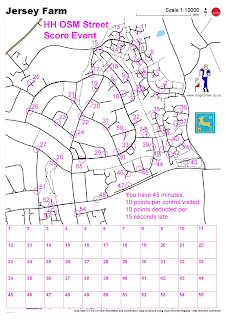
Not the most technical course even by Verulamium standards
Parkrun keeps coming up when people discuss how orienteering should be attempting to present itself, and today I got a first chance to try it out. The St Albans version started in January this year in Verulamium, one of our regular Saturday Series areas. This was also a chance to work out how we might need to modify Saturday Series arrangements to avoid any clash.

The idea is very simple: a 5km run held every Saturday morning in the same place. Entry is free but you need to register on the website beforehand. This allows you to print off a bar code to take with you. Then all you need to do is turn up on the start line and join in. I set off with 120 other runners as the bells of St Michael's Church chimed 9.00 o'clock. A show of hands on the start line showed quite a high proportion of first timers like me (nearly a third looking at the results) but the course instructions were quite simple: follow the guy in white and do three laps of the lake.

The race itself was pretty much what I expected: a few fast guys at the front, a few walkers at the back and quite a cross-section of shapes, sizes and speeds in the middle. I set off too fast as normal, and got passed by people as the race went on, including two runners about half my height who turned out to both be 14. Three laps of the lake is just about manageable before terminal boredom sets in and then it's just a short sharp 5 metre climb to the final long flat finish straight. My target had been 22 minutes so 21:55 was perfectly acceptable even if my watch did only register 4.95km. Maybe next time I won't do 5 km beforehand running to the start from home. After crossing the finish line you are given a small plastic tag with a finish position and bar code on it: the modern equivalent of the good old raffle ticket which nearly made it in at number 2 on my list of orienteering things you didn't know you had missed. Results are done using a phone to read your registration bar code (carefully retrieved from a plastic bag in the pocket on my shorts) and your finish tag, and the correlated with finish times recorded on the finish line. Results were on the website that afternoon and I even got a text message telling me how I had done.

So why is this proving so successful and what can orienteering learn from it?

The format is simple, easy to understand and accessible. Everybody has a reasonable concept of what 5 kilometres on a surfaced path involves. It's far enough to be a worthwhile run for most, but short enough not to put people off. And you don't need to keep looking at the fixtures list to find when the and where the next event is.

The technology is used very effectively. The website is attractive and informative. Registration and timing bar codes are simple and work well.

Requirements for volunteer effort are relatively small. Eight people are acknowledged on the results page. I spotted one finish timer, two on results download, and three or four marshals on the course.  Doing away with registration by asking people to do it on the website is a key saving.

It's free. To be honest I'm sure people would be willing to pay one or two pounds if asked, but if the financial model doesn't need it then this can surely only help to increase attendance.

Much of this is of course is where Orienteering on demand is trying to go.

Monday, April 30, 2012

Orienteering On Demand

Orienteering on demand results screen

After a lot of discussion I have finally developed a prototype of a web front end for my Orienteering on Demand concept. Helen has been looking at various ways of making permanent courses more usable (and used) and this often came down to some sort of mobile phone app. Last year we put together an Android app that read QR codes, recorded split times and then uploaded them to the web. What was really needed was a better web end to display results.

I've now put together a first attempt at that website. This turned out to be quite a lot easier than expected once I had discovered yii. (If you wouldn't know a PHP framework from an overgrown  re-entrant then don't worry. If you would, then yii is highly recommended.)

It's very early stages at present, but it shows a lot of the ideas. The bit I'm particularly pleased with is the GPX file upload. This allows you to upload a GPX file from a phone or watch, and then works out how close you got to each of the controls on a course. True virtual orienteering in action. The current site includes a few example GPX files of me running around the local park.

I'm still not sure quite where this is going. Do I want to run a single website for the world to use (the Winsplits approach) or would it be easier to allow clubs to run their own sites (the Routegadget approach)? Do I make it open source and let people add their own enhancements? Do I publish an API to allow people to interface their own apps? We'll see what the response is.

There's a lot more to do, but as a start I reckon this is now worth letting into the wild.

Monday, April 16, 2012

Westfield Orienteering


How difficult can it be to navigate round a shopping centre? Harder than you might imagine when it is Westfield overlooking the Olympic Park at Stratford, with four main levels plus three separate car parks each with nine floors. You can see a map extract on the left, and the full map is here. At one point I had to check the lift buttons to confirm that it wasn't possible to get to the Second floor of the shopping centre from where I was at the time. I least I didn't end up taking the lift between controls as many people did even if it is apparently quicker to go both up and down nine levels in a lift than it is to run the stairs. And just to put you off there was a view of the Olympic Stadium around every corner. I can confirm that the roof of Car Park A (that's level P9 if you are paying attention) should provide a great view of the Olympic Opening Ceremony. I wonder if they are selling tickets?

Meanwhile back at the orienteering, the event was the inspiration of Josh Jenner, who had negotiated access early on a Sunday morning, before the shops opened. The next master stroke was to convince Ollie O'Brien (the City of London Race mapper) to produce the map. Nearly 100 people took part, split over five mass starts at 15 minute intervals from 09.00 to 10.00. The start was headlong down the steps towards Stratford International Station, although some did turn straight round and head back indoors to avoid the cold wind. Control 101 was 10 m from the start horizontally, and an equal distance vertically. After that there was a chance to start working out how to join up all 28 controls on the 60m sprint to 102. I think it is safe to say that nobody will have come up with the same route.

I set out with the intention of simply doing a level at a time and working from the bottom to the top. This turned out to be a rather naive plan as it became apparent that getting between levels was not trivial. Stairs and elevators were helpfully marked with brown and blue arrows (brown for down to the earth, blue for up to the sky), but they weren't always where you wanted, and some were blocked off by building work. Just working out where the various bits of map joined together proved quite a challenge, not helped when you found out that level P4 in Car Park C was above Level P5 in Car Park A for instance. Controls were distributed across three terrain types: indoor shopping centre, outdoor ground level (including a trip to Stratford Underground and Bus Station) and car park roof level. You can see a few more photos here.

My GPS watch ended up showing 5.12km in 30.53, although it clearly struggled quite a lot with the indoor bits, and my route choice was far from ideal. Most people seem to agree that getting them all involved something around 5km, which for an area little more than 500m by 400m (by about 30m) is quite impressive. The results show that 39 people managed to get all the controls in the 45 minute time limit, plus quite a few who thought they had only to find they had missed one or two (or three or four...). James, Peter and Helen went round together and managed to get them all in 37:29 although this was apparently helped by having two maps so they could take it in turns to plan ahead and navigate.

A great day out, and one which will hopefully be repeated (and extended) later.

Tuesday, June 29, 2010

OpenOrienteeringMap from Start to Finish

Fancy putting on an orienteering event anywhere in the world but don't have a map? Then you've never heard of OpenOrienteeringMap. This amazing concept allows you to generate an orienteering map of just about anywhere based on OpenStreetMap, which describes itself as "a free editable map of the whole world". What this means is that thousands of people have been out and mapped everything they can find to create an on-line map. This has the huge benefit that it is open data, licensed under a Creative Commons licence (CC-BY-SA). Subject to certain conditions it is therefore essentially free to use as source data for other maps.

Ollie O'Brien, the man behind YepSport and the mapper for the London City Race amongst other things, has developed OpenOrienteeringMap that now allows you to generate an orienteering map based on OSM. This has been used by SLOW for their monthly street-O events around London. Last night I put on a Street-O in St Albans as part of the HH Summer Series to find out what was involved in staging a race like this.

First step as ever was to select an area. The north-east corner of St Albans is an area known as Jersey Farm. This has some complex housing estates joined by a network of paths which seemed just about right for a Street-O. To make life easy I decided on a 45 minute score event. So let's see what an OOM map of Jersey Farm looks like.

1) Go to http://oobrien.com/oom/. The default view shows Docklands. You can enter a postcode to go directly to somewhere in the UK, or use the zoom facilities to move to wherever you want to use for your map.

2) The default values of the various options are OK to start with. You have a choice between "Street-O Map" or "Pseud-O Map". The Street-O map is black and white and only shows features such as roads, paths, railways, rivers and large buildings. The Pseud-O map attempts to reproduce a standard orienteering map using the ISOM map specification. To me this looks much nicer, but for a street event it really isn't needed, and it's simpler to stick with the black and white version.

3) Once you have moved to the area you need then you can generate the map. Click on the "Create a map" button. This brings up the Map Builder window. You can then select the paper size, map scale and map type. There is also a check box labelled "Include controls". If you leave this box checked then you can add start, finish and controls to the map when you generate it. For my event I wanted to use OCAD for the course planning so I cleared the check box.
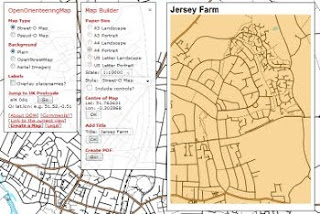
4) You then need to left click on the map to mark the centre of your map. This brings up a brown rectangle showing the exact size of your map. You can move this around as necessary by left clicking again, or by selecting a different scale, page size or orientation. For Jersey Farm I went for a 1:10,000 map. Once you have the correct area click OK, and then add a map title if needed, and click OK again.

5) You will now get the message "Creat PDF". Click the button labelled "Go!" and you will get your very own map in PDF format. This is named oom.pdf by default, so it is safest to rename it straight away and save it on your computer. You may well end up generating several versions of the map during the planning process so you need to make sure you are using the correct one.
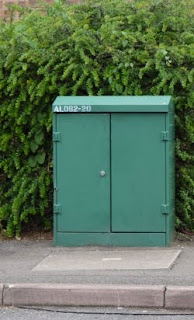
Now to plan the course. To make life easy you don't want to have to put out controls so you need to find some other way of proving people have visited the correct sites. SLOW use questions about something in the middle of the circle ("what is the name of the pub" and even "what sort of elephant is this" for example) . For me this is too complicated, since it makes life difficult for the planner to create the questions in the first place, and it is annoying as a competitor having to stop to write down long answers or hunt around for obscure answers. I therefore went for something simpler. Jersey Farm is covered in green telephone connection boxes, most of which have a nice painted number such as AL062 20. Getting runners to write down the last two digits seemed the best idea. A quick run around the area and I had found about 50 possible control sites. I still had a few parts of the map with no controls, but a quick hunt around on Google StreetView helped find a few more. It also raised hopes a few times when I spotted a fuzzy green shape in the distance only to find it was a green recycling bin. It turned out that runners at the event had exactly the same problem. The photos aren't quite good enough to read the labels so I had to do another run round to check them. In the end I went for 55 controls. This was probably a little over the top, but it does give runners something to think about.
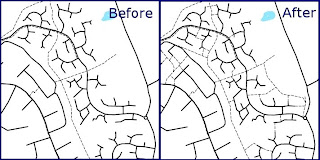
The event does of course rely on the quality of the OSM base map. In general it was pretty good, but whilst checking sites I did notice several things that needed changing or adding. The great thing about OSM is that you can always make the changes yourself. That isn't really what this is meant to be about, but for those who are interested I used JOSM to edit the map and add the odd extra road, several missing paths and some parks.

I wanted to use OCAD to generate the course. This won't accept PDF files as a background map so I first converted the PDF file to a JPG using GIMP. You can then use the standard OCAD course planning features. This allowed me to add the rules, a set of boxes for answers plus some extra logos. You can always use the built-in OOM function to add start, finish and controls if you don't have OCAD.
And so to the evening of the event. With no controls to put out it was simply a case of turning up at the start with a pen, clipboard and watch and setting people off. I put the start and finish at a green box so that people could see exactly what they were looking for before they started. Everybody got at least 19 controls, with the winner managing 42 in the 45 minutes available. You can see what routes some of the runners took on the HH RouteGadget site. The comments were all very positive, no doubt helped by the good weather and the interesting nature of the terrain. As ever there was much discussion about the map. The main issue was one I was already aware of from some of the SLOW events: open areas such as parks and fields do not show up. You can therefore end up staring at a large open space in front of you and wondering quite where you would come out if you ran across it, and whether you'll get stuck behind an uncrossable fence before you reach the road or path you want to be on. There's no easy answer to this, but it is generally fairly obvious once you get to the particular location. Using the full-colour Pseud-O map would help, and several people commented that they would prefer it.

Overall this event confirmed that it is perfectly possible to hold an event based on OOM. Jersey Farm itself turned out to be perfect, with surprisingly little traffic. Next time all I really need to do is move the start and finish and we could use pretty much the same set of controls. And then there's other bits of St Albans, and Mike said that Harpenden looks possible, and I've always wanted to do something in Hatfield, and then we could try Shenley or Welwyn or even bits of Watford. Looks like the Hertfordshire Street-O League may not be far away.

Sunday, September 13, 2009

Orienteering meets art in Trafalgar Square

On Friday September 11th 2009 Adrian had his hour of fame on top of the 1.7m (wide) x 4.4m (long) x 8m (high) fourth plinth in Trafalgar Square as part of Antony Gormley's One&Other project. This provides a chance for 2400 people (one an hour for 100 days) to occupy the fourth plinth and do whatever they want. Brooner came up with the great publicity angle that this could be the world's smallest orienteering event. Around 20 other orienteers and even a few members of the public took the chance to run in the first orienteering event to be held in Trafalgar Square.

The whole thing was broadcast live on the internet, as indeed all 2400 hours of the project will be. Looking at the coverage afterwards it may have been a bit difficult to work out what was happening at the time, and even if you were there it wasn't immediately obvious. Adrian was so far above us that it was quite hard to communicate, especially over the noise of the fountains. The theory was that he would run a course on the plinth and then someone would run the equivalent course in the square. It soon became obvious that this was a bit difficult to synchronise so it turned into more of a straight relay.

The extra complication was that each course would outline a letter and everything would be recorded on a GPS watch that was passed from runner to runner, and if we got everything right then we would spell out a message. Alan Leakey was given the job of official starter and a set of maps with courses labelled O, N, E, &, T, H, R, P, L, I and G. His job was then to hand these out in the right order to spell the message. Orienteers from London Orientering Klubb, South London Orienteers, Southdowns Orienteers, Hertfordshire Orienteering Club, Chigwell Orienteering Club, Havering and South Essex Orienteering Club, Saxons Orienteering Club, South Midlands Orienteering Club and possibly a couple of clubs I didn't spot took part. The South Midlands runner was Roger Williams, who had already had his own hour on the plinth a few days earlier.

Discussions with Adrian before the event had concluded we had a chance of managing "ONE & OTHER PLINTH O" in the one hour available, but the unofficial target was to try to manage "ONE & OTHER PLINTH ORIENTEERING". As we came towards the end of the hour we had got to the T in orienteering, but Alan was desperate to finish off. The bright yellow cherry picker drove up to get Adrian down and replace him with the next plinther, but we relocated the start and finish a few metres and continued around it. I spotted that we could stop at "ORIENTEER" and that would still make sense, and even provide a better reference to the person who had started all this off in the first place. And so at just past 14.00 I set off on the final R, telling each control holder as I passed that we had finished. In total we had run 24 courses covering 8.56 kilometres in 52:47.

After the event it was simply a matter of downloading the GPS track and extracting the message. The good news was that we had a full trace from the whole race. The bad news was that my vague idea of doing something in Routegadget to extract the letters didn't really work. After some experimentation the final method turned out to involve quite a complicated process as follows:

1) Read GPS trace from Garmin Forerunner 205 using SportTracks and create a GPX file for each letter.

2) Import each GPX file into QuickRoute and use this to create a JPG image showing the letter. QuickRoute had the nice extra that allows the colour at any point to indicate how fast you are running. Thus green sections show bits where people were moving fast, whilst red is slow.

3) Use IrfanView to do a batch conversion of the JPG files. This provided an easy way to crop and resize all 24 letters without doing it painfully one at a time.

4) Create a 9 by 3 Word table and import the JPG letters into this for final printing.

And so as a contribution to the art created in association with this project we come to the final result, as shown below.

The start and finish are at the bottom left of each letter, and this means courses have to be planned so they don't go through this point. That explains why the E is backwards, the T is on its side and the L is upside down.

A few related links:

Thursday, September 10, 2009

Tower, 52m, northern foot

Any suggestions where this might be? I guess it's not really that difficult to work out that it is Nelson's Column in Trafalgar Square. Tomorrow the general public will be getting the chance to orienteer around the square when Adrian Bailey spends an hour on the fourth plinth as part of the One & Other project. Helen and I have been helping to set things up so I am mapper and planner and Helen is organiser for what promises to be an interesting experience. We're still not quite sure exactly what will happen, but we have maps, control flags and SI kit so it should look like a proper race. Brooner has found an interesting publicity angle, claiming it to be the World's smallest orientering event.

You can get a sneak-preview of the map in Routegadget.

If you can't be there, don't miss the live web broadcast from 13.00 to 14.00 BST.

And that should provide a perfect warm-up for the 2009 London City Race on Saturday.

Thursday, October 16, 2008

City of London Orienteering Race

What an event. If you haven't seen it I recommend starting by looking at the map and courses in Routegadget and then seeing gg's video. Then there are the results plus lots of pictures, discussion and comments from officials on the official event web site.

The map, produced by Ollie O'Brien, is a pure work of art. There laid out in front of you is the whole City of London, from the remains of the Roman walls (in the olive green just north of control 135) to St Paul's Cathedral (control 151) to modern skyscrapers such as the Gherkin (control 137).

This was a chance to orienteer around the streets of London, which on its own would have made a great day out. The street network is not particularly complex, but it is good enough to make the navigation interesting, and around every corner you find a view of some well-known building to distract you. The start and finish were in Broadgate Arena next to Livepool Street Station (as shown in the photo of prizegiving on the left). The majority of the 400 competitors arrived by public transport and could sit in the warm sunshine while they waited to start or to discuss route choices after they had finished.

But the added element on top of all that was the final few controls spread around the Barbican Centre. The is spread over multiple levels, and proved a real challenge to map. Never before have so many people been so confused by so few controls.

It's also worth looking at Ollie's web site where he explains some of the technology behind the race.

Wednesday, September 17, 2008

Don't Miss This


I spent last Saturday checking control sites for the City of London Orienteering Race on October 11th. All the photos in the mosaic on the left were taken from somewhere on one of the courses. Despite having lived and worked in London for over 25 years I still visited places I had never been to. At one point I was in a deserted maze of narrow alleyways behind the Bank of England when a lone runner came round the corner at high speed. It was Brooner, the Event Organiser, out test-running the long course. I said these alleyways were just like Venice. He thought it was like Istanbul. In future you can say that other places are just like the City of London. Ten minutes later I met him again in a deserted churchyard. The map is a true work of art on its own.

Don't miss it. This will be something special.

Click here for an enlarged version of the picture.

Sunday, July 20, 2008

Golden Graham (and JD and Jamie)

What can you say. GG cruises round to come back fourth. JD decides that isn't good enough and comes back in the lead. Jamie is caught by Thierry and then Novikov. Clive Allen convinces us all that France and Russia are fighting for the Gold with GB settling for Bronze. Jamie suddenly catches Novikov back up despite a longer gaffle. Thierry swallows a bee, gets stung and ends up walking. Jamie's TracTrac route shows him missing control 25 by miles, but somehow he ends up in the lead at the next control and is clearly running much more strongly than Novikov. And that's the race over. JD and GG struggle to keep up with Jamie down the run-in, Dave Peel gets in on the act on the finish line and GBR have a third WOC Gold medal. Just how WOC should always be.

There has been much Nopesport comment about the shorts. You will see from the attached photo that GG was already sporting them at WOC 2008 in the Ukraine when they lined up for this "we'll be World Champions this time next year" photo.

Having now had a chance to watch the Czech TV coverage it strikes me that it was excellently done, especially given that it went out in real time. (The internet streaming from the Czech TV website simply wasn't up to it during the race itself). TracTrac almost proved its worth, but the loss of contact and occasional strange position reports mean that it can't quite be relied on to fill in the gaps between even quite a large number of TV cameras. Clive did a valiant typing job, which I then had to balance with numerous (and in fact too many) on-line radio controls, plus trying to keep up with the Test Match at Headingley and the Open Golf at Royal Birkdale as well. If I was a betting person I might be asking for a steward's enquiry to work out quite what went on in that mad last ten minutes, and I'm sure we'll be hearing a bit more detail from those involved.

But for now we can just celebrate the new records: first British Relay Gold, Jamie becomes a double World Champion, GG becomes the 10th Brit with a WOC medal (and saves himself a BOF membership fee for life I'd expect). And just for me, my ongoing prediction of the emergence of China took a step forward with 7th place in the Women's race, and we had a fourth WOC race where Sweden, Norway and Finland failed to win a medal, and the third of these four where GBR won the Gold. Quite astonishing.

Friday, July 18, 2008

Another Full Set

How many runners have claimed a WOC medal in all four disciplines, counting Short and Middle as equivalent for these purposes? Remember Sprint only started in 2001 so many people never had a chance.

A quick think about it brings up the obvious candidate: Simone Niggli. After that I was struggling, but some analysis showed that Minna Kauppi has also got one of each. And then at yesterday's Middle race a third person joined the elite group when Vroni Koenig-Salmi claimed silver and completed a full set of Sprint, Middle, Long and Relay medals. The photo shows her on the way to Gold in the Sprint in 2001 in Finland.It also shows what may be the least attractive control site in WOC history: Tampere Greyhound Stadium toilet block, NW corner.

So who else could join this group in the near future. Looking just at runners at the 2008 WOC with three types of medal already we find people missing teh following types of medal:
  • Sprint: Heli Jukkola, Marianne Andersen
  • Middle: Andrey Khramov, Emil Wingstedt , Matthias Merz
  • Relay: Yuri Omelchenko
  • Long: Jamie Stevenson, Pasi Ikonen, Thierry Gueorgiou
The Sprint and Middle are over, so those five have missed out. I can't see the Ukraine sneaking a relay medal so it surely won't be Yuri. Pasi and Thierry aren't running the Long so it won't be them. But it just could be Jamie. One extra thing to cheer him on for on Saturday.

(Just for completeness, Valentin Novikov would have needed a Long and Sprint medal.)

And one final statistical excitement from yesterday. The men's race was only the third race in WOC history that Norway, Finland and Sweden all failed to win a medal. Unfortunately for me this was the first time it had happened when Great Britain didn't claim the associated gold medal.

Wednesday, July 16, 2008

Looking for a Level Playing Field

I'm fascinated by the question of which countries do best in which races. I guess this is partly driven by the British love of the underdog, so any "unexpected" success is to be applauded. Come on China (as long as you don't beat the GBR runners).

So it's time to look at the numbers. Take all individual WOC finals since 2001 (when the Sprint race was introduced). Allocate 50 points to the winner, 49 for second and so on for all finishers. Add up the scores for each country. Then to allow for the fact that I have included the 2008 Sprint race result already, normalise by looking at percentage of the total number of points scored. What do you get and what does it mean?

What you get is the table at the bottom of this post. What it means is much more open to question but let me offer some thoughts. Little if any of this is statistically significant, but it's fun anyway.

1) The totals column shows that world orienteering falls neatly into four groups.
  • At the top we have the big four: Switzerland, Sweden, Finland and Norway. They are in fact remarkably evenly balanced on the calculations used here.
  • Then we have a group of eight countries with consistent solid results: Russia, Czech Republic, Great Britain, Denmark, France, Lithuania and Australia. Russia are probably making the move towards the big time, but I'd need time to do some moving average calculations to back this up. Lithuania and Australia are possibly surprise nations at this level.
  • The third group consists of Estonia, Ukraine, Latvia, Poland, Slovakia, Germany, Bulgaria, Austria, Italy, Hungary, Romania, Spain and New Zealand.
  • And then there is a fourth group of everyone else, none of whom are even yet close to making the move up to the third division.

2) Looking at the Sprint race column:
  • Finland, Norway, Russia, Estonia seem to do worse in Sprint races than their overall performance. Norwegian and Finnish results appear very bad indeed in comparison with the other two disciplines.
  • Great Britain, Austria and possibly Japan, the United State, China, Croatia and South Africa seem to do better in Sprint races than their overall performance
3) Looking at the Middle race column:
  • Great Britain, Denmark, Bulgaria, Hungary and Belgium seem to do worse in Middle races than their overall performance.
  • Finland, France (the Thierry factor), Lithuania, Poland, Belarus and the Netherlands seem to do better in Middle races than their overall performance
4) Looking at the Long race column:
  • France, Lithiuania, Australia, Poland and Japan seem to do worse in Long races than their overall performance.
  • Norway, Russia, Estonia and Germany seem to do better in Long races than their overall performance.
5) Switzerland and Sweden are notably consistent across all disciplines.

6) A final note of hope for the smaller nations: the only appearances of a "big four" nation in the "worse than normal" list are Finland and Norway in the Sprint race. This is the discipline where you probably have the best chance of success, whatever that means.

It's the Middle race tomorrow. Watch out for Finland, France, Lithuania, Poland, Belarus and the Netherlands I reckon.

Monday, July 14, 2008

TV or not TV...

Well that was fun. Everything about the Sprint Race looked good, with a fantastic old town centre as a start and finish area, a detailed area of parkland and gardens right next to the town to provide some intricate control picking, some really tricky long route choices and more TV cameras and radio controls than I could believe. Juggling the internet technology proved quite hard as you ended up trying to keep three or four split time windows open at the same time as leaving the live TV feed visible. The TV quality via the internet was a bit variable, and the radio controls seemed to stop updating occasionally, but overall there was certainly enough to keep me interested for both races.

Czech TV seemed to settle for presenting the event as a race rather than anything more complicated, which seemed to work fine. There was no tracking, and only brief glimpses of a map, so the navigational element of the coverage was minimal. But for sprint races you can get quite a good feel for what is going on just by watching someone standing still and panicking for two or three seconds just the wrong side of a flower bed. And there was certainly some pretty impressive control flow to watch as well as contrasting techniques for crossing the water feature. Trying to make the coverage any more complicated, especially in real time and with such a short winning time, probably isn't worth the effort. Maybe it would have been interesting to focus in the big route choice decision from the start triangle: left or right? The first starter went left, most of the rest seemed to go right. Perhaps the Czech commentary picked up on this. They certainly spotted Emil Wingstedt leaving out a control, although this led to little more than slightly raised voices talking a little faster than normal. We got to see people clearly running very fast and also clearly having to navigate very carefully. Overall I thought it was great, but I guess the question is whether it would attract non-orienteers.

In terms of results it looks like a game of two halves: men and women. For the men there were 11 countries in the top 12 places, with many of the lesser nations such as Slovakia, Lithuania, Austria and the Ukraine fighting for top places. Khramov and Hubmann were simply in a class of their own, but the next 30 runners finished within a minute. The women's results show a different pattern. In what should surely be the most open women's race of the Championships the top 17 places all went to runners from the traditional orienteering strongholds (allowing myself licence to include Great Britain and France in there). The first "minor" nation was China in 18th place. Two of the three Chinese women mispunched, but they can clearly run pretty fast. Surely the sprint will be where they finally break through, but how long will we have to wait?

Saturday, July 12, 2008

Born to Run

So was JWOC the biggest thing to hit Gothenburg last week? To be honest it probably didn't even make it to top of the list of little things to hit Gothenburg last week. Dominating the city were two things: Bruce Springsteen playing two nights at the Ullevi Stadium as part of his latest World tour, and the Partille Cup. This seems to be the handball equivalent of O-Ringen, and had attracted 20,000 handball players from around the world. Walking around the city centre there were flags and banners publicising handball everywhere, as well as many teams all of whom seemed to be six inches taller than the average Swede. As for Bruce this seems to be the biggest thing that will happen to Gothenburg this year judging by the newspaper coverage it generated. Ironically some of the JWOC runners I talked to didn't even know who The Boss was, but he does let me get in one of the all-time classic orienteering song titles. For me he also provides one of my main memories of APOC 1990 in Canada when a "three in a row" slot on the radio featured Bruce as we travelled through Calgary.

But getting back to JWOC it was really business pretty much as usual for the Long and Relay. No great surprises at the front (other than possibly how close the men's Long race was), and another set of British results that were difficult to get excited about but equally weren't too bad. How many times have I said that about Brits at a World Championships? Given the other distractions in Gothenburg it was always going to be difficult to get much attention for JWOC. Even so it did seem to be a very small and inconspicuous event, and I was particularly surprised at how few Swedes turned up on home terrain to cheer on a stream of medals.

WOC 2008 starts tomorrow in the Czech Republic with the Sprint race. One question that does arise is to what extent success at JWOC feeds through into success at WOC. It seems clear that not every JWOC champion progresses to the very top level at senior level, and it is equally clear that success at JWOC is not necessary to make it to the top at WOC. Perhaps something to look at further when I have some time, but for now the real thing is about to start. Time for some serious internet spectating I think.

Friday, July 04, 2008

Fair to Middling

Another day of unbroken sunshine shone down on another small crowd at the JWOC Middle Race Final. The Danes re-appeared to make some noise, but the Swedes stayed away again, possibly because it was difficult to find out exactly what was going on and where. As Middle races go this was was rough, tough and technical. The courses were dominated by semi-open rocky ridges with legs across them requiring quite an effort to stay upright on the rocky surface as you scrambled up and down. Add in some bushy vegetation in places and it was perhaps unsuprising that the Scandinavians dominated the results, with the Swedes really getting it together on home terrain. For the Brits it wasn't the greatest of days, but then it wasn't the worst of days either. Let's see how the final two races turn out.

Loking at the results it was probably the French who had most to celebrate amongst the lesser nations, with a bronze medal plus a 10th in the Women's course. Perhaps Thierry has been passing on his secrets.

Wednesday, July 02, 2008

A Qualified Success

GB JWOC 2008 Team signalling for help
After a brief interlude for the Model Event yesterday it was back to real business today with the Middle Race Qualifier. The Sprint and Long are run as straight finals (on the basis that there isn't time to stage the necessary qualification races) but the Middle has a proper Qualifier with the added pressure that brings. Nobody won a medal today, but some may have lost one by not making the final. The JWOC Rules allow everybody to run everything, so with a possible team of six men and six women several countries were aiming to get twelve runners into the A Final by finishing in the top 20 of their heat.

The sun shone down on the Race Arena in a shooting range that was doubling as a commercial stinging nettle plantation. As ever at Qualifiers the atmosphere was restrained, and even the Danish fans seemed to have stayed away for this one. The normal stream of runners emerged at various speeds down the hill and into the field, and the confident ones then jogged effortlessly to the Finish. For most people this was a last chance to pick up one or two seconds that might be vital at the end of the day, even if it would have been easier to save the one or two minutes that had disappeared at controls in the forest.

And as ever the question was simply how many people did you get in the final? A quick look at the results (helped by using some of the clever analysis features of Winsplits Pro) produced the table below. Norway managed a perfect 12 and I would probably have guessed the top eight countries correctly beforehand. Great Britain look to have had a pretty good day (helped by what seems to have been a late disqualification), and ended up doing better than the in-form Danes. Further down a few things strike me It seems odd that France only have a team of nine. Three Belarus qualifiers out of five looks like a pretty good performance. Canada and the Netherlands will probably be pretty pleased to get runners to an A Final, but Australia look like they had a bad day, especially when New Zealand ended up doing better. The Ukraine are probably the most surprising absentees from the A Final. And as a final note it seems like this is a very similar set of results to what you would get at a full World Championships. Is the terrain here in Sweden just too technical, or is there really no change in prospect to the world order just now?

CountryQualifiedRan
Norway1212
Finland1112
Sweden1112
Russia1012
Switzerland1012
Great Britain812
Czech Republic712
Denmark712
Estonia611
France59
Germany46
Poland48
Hungary49
Belarus35
Lithuania312
Belgium26
Austria210
Italy210
New Zealand210
Spain210
Netherlands13
Bulgaria14
Canada18
Latvia110
Australia112
Croatia01
Slovakia01
Romania02
South Africa02
Slovenia03
Ireland04
Hong Kong05
Portugal05
Ukraine07
USA09
Japan012
Turkey012

Tuesday, July 01, 2008

JWOC (and Database) Up and Running

Here we go again with more reports from another World Championships – but this time it’s JWOC, the Junior World Orienteering Championships in Gothenburg. The first thing to say is that the Maprunner website has now been updated and includes a fully searchable JWOC Database in a similar format to the WOC Database.

This is my first time at a JWOC, and it’s not something I’d normally expect to be at. But next year I am the IOF Event Adviser for JWOC 2009 in Italy, so this is a chance to find out exactly what is needed and how JWOC differs from the World Championships themselves. A quick visit to the Event Centre at an army camp this morning felt almost as if nothing was happening, with little sign of what was going on other than in the Event Office. This had the normal stream of last-minute queries, plus a host of competitors and officials gathering to use the wireless internet access.

A short bus trip to the start area for the sprint race and things began to look a bit more hopeful. Teams were setting up tents around the start, even if things were still quite low-key. The ten minute walk to the Race Arena in a football stadium was surprising mainly because it was through a large wooded area with outcrops of bare rock and no sign of the “80% urban terrain” promised in the details. The Arena gradually filled up, and as we reached 12:30, first start time, it began to feel like something was happening. Even so there are very few people present, and to an outsider it’s probably quite difficult to work out what is going on.

The terrain from what can be seen near the finish turns out not to be anywhere near as “urban” as expected. Walking along the road that passed the last few controls on each course there were runners coming down quite steep semi-wooded rock outcrops to pick up the road on the way to controls spread around groups of cottages. Only those making mistakes (of which there seemed quite a few) ended up on the wrong side of the road and in the housing estates and car parks. Even the last control on the children’s play area caught some out as they ran around in the bushes behind it. Having had a chance to run the course later in the spectator race it turned out to be quite an interesting combination of houses surrounded by rocky outcrops and woodland.

Talking of the spectator race this would have been really quite a select event if it was really restricted to those who turned up to spectate, since the number of spectators was quite small. Apart from the expected small groups of proud parents the only real group to make their presence felt was from Denmark, and it was almost impossible to tell that the race was taking part in Sweden. Loud outbreaks of cheering, clapping and flag-waving met each Danish runner as they entered the football stadium and sprinted the final few metres on fast running provided by the artificial turf. The only thing to slow people down was the 90 degree bend they had to negotiate half way down the run-in. They then passed through the latest high-tech finish arch, which not only had a light beam for timing but also a magic device to read the runner number from the bib. Final details asked runners to use eight safety pins to ensure the bib stayed on during the race. The good news for the Danes was that all their noise had the desired effect, with gold for Emma Klingenberg in the women’s race and bronze in the men’s race. Stephan Kodeda of the Czech Republic won the men’s race, with six different countries represented in the top six including a notable fifth place for Andrea Seppi of Italy.

And then it was off (via a complicated arrangement of buses and trams) to the Liseberg amusement park for the opening ceremony. Being a true connoisseur of such things, this got several aspects right including being relatively short and avoiding the temptation to display any form of traditional dance activity. What it did have was a very loud rock band and a lot of bemused locals looking on as they tried to work out what was going on. It also had Kent Olsson to declare JWOC open, looking somewhat older and larger than I remember him. He was World Champion in the Classic Race in 1987 in France. I know. I was there.

Sunday, August 26, 2007

WOC 2007: More of the same but faster

And so we have made it to the final day of WOC 2007, and we start as we began with the sprint. By now the routine is familiar: dodgy breakfast in the Hotel Tourist (porridge, muesli or omelette are the three choices for the "sport" menu, plus tea or coffee if you persist long enough, and milk to put in it if you grab a carton from an adjacent table), a steamy trip in a packed metro, and arrival at a sunny event arena to find Per Forsberg on the commentary gantry getting excited about just about everything as only he can. The men are off first in the sprint, and the Botanic Gardens provide quite a nice setting, even if there does seem to be an awful lot of tape around trying to keep spectators away from places they really would like to go.

For the first time we get to see runners starting, and then there are two spectator controls on the edge of the arena plus a long finishing straight that is to prove decisive as it turns out. Sprint ace Emil Wingstedt starts early after his scare in the qualifier and puts in a good time, but it will not be enough. We then concentrate on the three Brits starting at two minute intervals. They all have excellent runs (GG 12th, Jon 16th, Jamie 18th) and Britain finishes top country based on the finishing position of their third runner. GG gets most attention at the finish as he runs into third position with over half the field already finished. Yet another good day in the sprint for the British.

Sirmais comes in near the end to give a Latvian leader, but is narrowly overtaken by Hubmann and then Johansson. At this point there are seven seconds covering the top five runners. Matthias Merz reproduces his form from the long to open up a massive 19 second gap at the top and there is only one person left on the course. The flying Frenchman appears at the final control and no-one can be sure who will win. Thierry gives it everything to take one second off Merz on the run-in and claim the gold by nine tenths of a second. Pure genius.

The women's race wasn't quite as exciting, but the result was again pretty predictable. Niggli first, Kauppi second, and eight Finns, Norwegians and Swedes in the top 10, joined only by new World Champion Niggli and ex World Champion Allston. Is women's orienteering really that boring and predictable in what should be the discipline most open to other countries?

After everything was over I happened to be in the right place at the right time to buy a sprint race map from an enormous scrum of people, so took the chance to have a jog round some of the men's course. The area was a mixture of formal gardens, buildings and thicker wooded areas with quite a dense path network, all set on quite steep hills. There were some significant route choice options, although it may have been more a case of picking one and doing it well rather than finding a killer route choice. Talking to GG afterwards he said he really wasn't sure about some of the routes he took, but clearly the final result was OK.

As I jogged past the arena at the end I heard an announcement that the WOC Tour prize-giving was about to take place, so Helen and I just managed to get back in time to claim our certificates and cuddly toys for hard-earned second and third places overall. Then it was time for some final sight-seeing on the last afternoon. The nearest attraction was the enormous (over 60 metres) "Iron Lady" statue that dominates the Kiev skyline from the east. We led a group of other orienteers down a path that eventually ended up leading us through a cemetry and past an underground church before emerging on a dirt track through what looked like somebody's garden gate. We later found that everybody else had come down this way as well. The dirt road turned out to be up-market Kiev and was lined with enormous houses complete with CCTV and tinted glass in the large cars parked in each driveway. Finally we got to the bottom of the valley and started the climb up to the status and associated war museum complete with tanks, missiles, guns, boats, helicopters and huge statues of a kind only Eastern Europe ever seems to produce. From there we decided to get a taxi to the other end of town to see the final remaining sights: St Andrew's Church and the road leading down from it lined with people selling all sorts of Ukrainian items ranging from the expected postcards and Russian dolls to the slightly less expected deer skins complete with attached deer heads.

Saturday, August 25, 2007

WOC 2007 Relay: No change there

Today was relay day and we were back amongst the windmills in the same event arena as for the long race. If you don't want to know the score look away now... All six relay gold medalists from Denmark in 2006 won again today, with an unchanged Russian men's team and Finnish women's team coming home first. To be honest there were no real surprises at all, with the top 10 in both races looking fairly predictable. But the races themselves did provide some decent head-to head competition.

The women set out first, in temperatures which were at last a bit more bearable than earlier in the week. Pippa Whitehouse had a great run for GB on the first leg coming back in sixth place just ahead of Switzerland. The Finns gradually pulled away on the second leg, but Norway and Sweden were together in a battle for the places, with Simone Niggli setting out in fifth place on the shorter last leg with an outside chance of a medal. In the end the Swedes just beat the Norwegians to take silver, and the Swiss ended fourth.

Graham Gristwood set out on the first lap for the men and was in the leading pack out of the field. He was still in the lead at the first radio control before losing a few places and eventually finishing 15th, but under two minutes down. Things continued pretty tight, and Jon Duncan moved up a few places to send Jamie Stevenson out with Thierry Gueorgiou in a fight for sixth place and the last spot on the podium. Thierry won that battle, whilst at the front the Russians were opening up a small but adequate lead ahead of Finland and Sweden.

And then after what had already been a very long day for spectators it was time to head out on the WOC Tour races and get a chance to sample the terrain at first hand. My start time was 17:34, and which point I had already been in the field for nearly eight hours. Despite this I managed a pretty reasonable run. The complicated valley network turned out to be even steeper and muddier than expected, and my route choice along a marsh in the bottom of a valley was a little on the slow side. There was quite a lot of the course through the cottages and other buildings in the museum itself, and then a final two kilometres through very fast white woodland with excellent visibility, very similar to the Chilterns in places. The museum is enclosed within a three metre high metal railing fence, and World Champs runners had been provided with bridges to get over this. For some reason the organisers decided that mere mortals could do without this luxury, so we were left to climb these fences or find unmapped gaps in them. Helen ran past a pile of wood that turned out to be the dismantled bridge that she was looking for at the time, and I had to help a woman over a fence before I could cross it. Our course was pretty much the same distance as the last lap of the men's race, and the good news is that my time means I would be a safe bet to make the Kazakhstan, Israel, Hong Kong and South Africa teams, and even the Chinese team which is a bit of a surprise.

Helen had already predicted that getting home that night would be a challenge, especially when the organisers announced that the last bus would leave at 19:00, despite the fact that many people would not have finished by then. We finally left the event arena about 19:15 and got to the bus pick-up point at around 19:30. Given the events of previous days we decided it was safer to get the public bus that arrived not long after, so seven of us set off on a mystery tour hoping to find a metro station, at the extortionate price of 15p each. This worked OK, and we finally got back to the hotel at just after 20:30, a mere 12 hours after we had set out. You have to be fit to be a spectator at this WOC.

Friday, August 24, 2007

WOC 2007: Independence Day

Today was Independence Day in the Ukraine and so a public holiday. The good news was this meant that the metro was a little less crowded than normal, at lest going into town in the morning. We had decided to do some quick sightseeing to tick off a few more major sights before heading for the WOC Tour Sprint Race. We started out at what should have been the Great Gate of Kiev, or at least a replica of it. It was a bit difficult to tell what it was at all since everything was covered in scaffolding and blue plastic sheets. Next we headed for St Sophia Cathedral, only to find it swamped by a huge crowd sitting out in the bright sunshine listening to long speeches, complete with marching bands and live TV coverage. Many of the crowd were dressed in full dinner suits or posh dresses, often topped off with what appeared to be paper hats to keep the sun off. Interestingly this turned out to be the only occasion in the week when we saw any giant TV screens: they never made it to any of the events.

A quick stroll down the boulevard led us to St Michael's Cathedral, and then there was just time to get the funicular railway down the hill to the metro station and head south to the bus pick-up point. We got there 10 minutes before the first bus was due to leave, and just managed to get on before it set off early. We were then dropped off in a park not far away, and wandered around watching the various festivities going on. A large stage was set up next to the finish, and at various points through the afternoon had magicians, dancers, bands and various other forms of entertainment. There appeared to be some sort of sporting festival going on as well, with people playing table tennis, football, darts (I kid you not, although they were throwing from about 5 metres away which reduced the skill level somewhat) and an entertaining variation of skittles that involved throwing metre-long sticks at assorted blocks of wood to try to knock them out of a marked area.

There was also a dog training class going on, with some rather large and fierce dogs doing tricks. This somewhat complicated the orienteering when the organisers emerged to set up the spectator control on a tree in the middle of the dogs. Some runners later in the day weren't willing to risk getting too close to the dogs, and decided not to punch the control. Ukrainian SI kit is of the ultra-robust variety. All control units come encased in a metal box that is screwed to two stakes. This is then connected by a wire to the nearest large object. This is so big that it can look like a taped route away from the control at times. It also provides quite a trip hazard, and several times during the week I ran into the wire at speed. For some reason the World Champs competitors have missed out on this technology, and get standard boxes plus back-up punch on their stakes. It then seems that the organisers change every control site before the WOC Tour starts.

The sprint race itself was in very pleasant terrain being mainly very runnable open forest with scattered open areas, although it was quite steep in places. Our planning featured an unfortunate dog leg at the end when we ran all the way to a lake at the bottom of the hill before running back up the same hill to the finish, but overall it was a chance to run at a sensible speed at last. Helen even managed to win her course.

Then it was back to the hotel for the traditional British Team picnic. This took place on the 24th floor of the Hotel Tourist, providing spectacular views over the Dnipro River towards central Kiev. Attendance was a little on the low side, given that so few spectators have been brave enough to make the trip. Later that night we returned to the 24th Floor to watch what was meant to be a spectacular fireworks display at the end of Independence Day. This turned out to consist of individual fireworks going off at quite long intervals, so we soon gave up and went to bed. Apparently the real display started just after that.

Thursday, August 23, 2007

WOC 2007: Phew what a scorcher.

So far the week has been hot. Today it go hotter. The spectators could look forward to four hours in a field with temperatures in the high 30s and no shade. This was probably only marginally less physically tiring than having to run 18 kilometres with over 500m of climb as the men had to do. We got an early lucky break when the organisers suddenly found an extra bus to take people direct from the hotel to the event, rather than having to brave the metro again. The bus dropped us off at the entrance to the Ukrainian Museum of Folk Architecture and Life, a huge open-air museum consisting of cottages and churches spread around semi-wooded countryside. Those of us who stopped to take photos of the two windmills near the entrance found we needn't have bothered, since the event arena was dominated by five windmills on a hill top, with a sixth acting as a spectator control. Somehow the organisers managed to squeeze the spectator control and map exchange into a tiny corner of a huge field, so photo opportunities and spectating were not what they should have been. Helen, James and Peter spent most of the day sheltering under a makeshift tent made of towels over a fence post near the last control.

It was clear from early on that the courses were long and tough. The commentary team hinted that there was one leg of over three kilometres: this later turned out to be predominantly through or round a built-up area. Early starters looked hot and tired as they ran down to the windmill for the map exchange and the final loop, and were significantly down on predicted times. Gradually the times got faster, as they are bound to do given the reverse start order from qualification, but there was seldom any real excitement in the field. It was probably just too hot.

In the women's race it was business as usual, with the top 6 being no surprise at all. What was a surprise was that Kauppi and Jukkola took exactly the same time (80:17) to give Finland two gold medals, and that they both beat Simone by well over a minute. The splits show Jukkola lost 10 seconds running the wrong side of the building at the last control, but they then both did 22 seconds (fastest time for any woman) down the run-in. Helen Winskill ended up 32nd and Pippa Whitehouse 42nd.

In the men's race two big names dropped out before the race (Lauenstein ill and Lakanen injured), and seven more failed to finish or were disqualified. Matthias Merz of Switzerland took his chance to do a Thierry (who had opted not to run the long) and won by a huge 3:38 margin. As with the middle, there was then a large group, with ten runners in the next four minutes. Jamie Stevenson finished 9th and Jon Duncan 18th.

We couldn't face any more time in the heat so left before the prize ceremony and headed for the beach again. It's a day off for the big boys and girls tomorrow, but we get a chance to see what the sprint qualifier area was like. Strangely the whole of the sprint qualifier area is on the long race map, and provides an interesting comparison of a 1:15,000 map and a 1:5,000 sprint race map.